Programming
Chest Workout: 6 Exercises and 3 Session Plans for Bigger Pecs
Build your chest with six proven exercises, a weekly set target and three session plans for the gym, dumbbells only or home. Film one set to check your range.
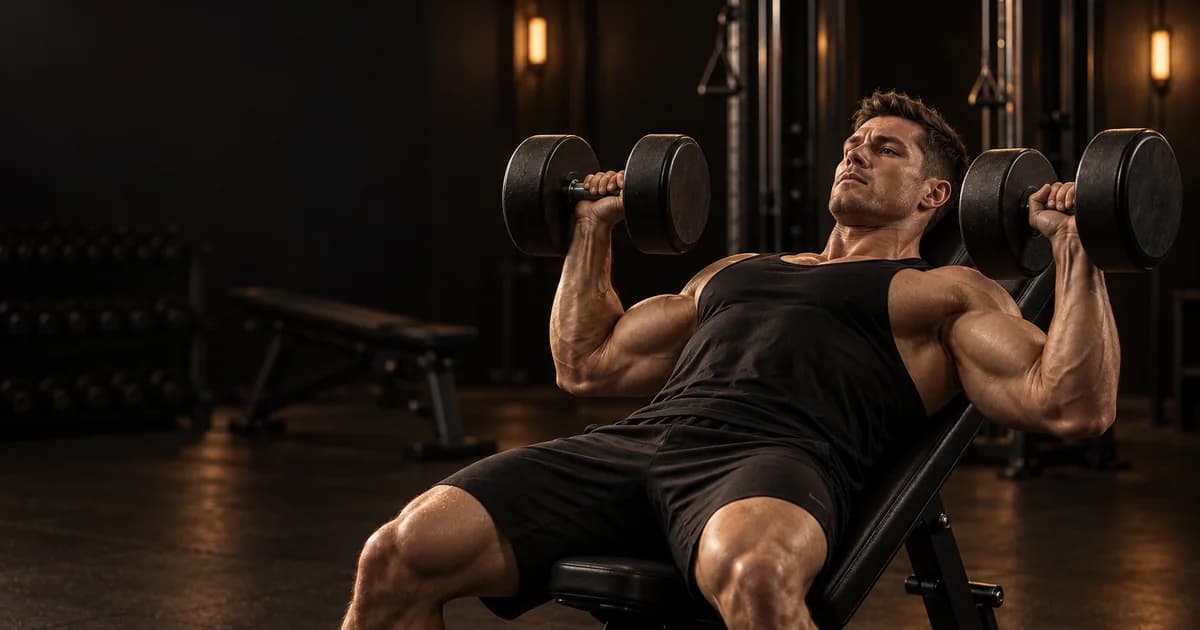
A good chest workout uses two or three pressing movements plus one fly, trains your chest twice a week, and lands between 10 and 20 hard sets across that week. Pick one flat press, one incline press and one fly or dip. Take most sets within one to three reps of failure, add load or reps when your range stays full, and film one set so you can prove it did.
The rest of this guide gives you the six exercises worth your time, how to split them across a week, and three ready-made sessions for a full gym, dumbbells only, and home.
What actually builds your chest
Your pecs grow from enough hard sets, taken close enough to failure, through a full range of motion, repeated over months. Three findings shape every plan below.
- Weekly sets matter. A 2017 meta-analysis by Schoenfeld and colleagues found a graded dose-response: each extra weekly set was associated with slightly more growth, and groups doing 10 or more sets per muscle per week tended to grow most.
- Frequency is a scheduling tool. When total weekly volume matched, training a muscle once or three times a week produced similar growth in a 2019 meta-analysis. Two sessions simply make 12 to 20 good sets easier to perform with fresh form.
- Bench angle shifts the emphasis. An EMG study of five bench angles found the upper (clavicular) chest most active at about 30 degrees, while the middle and lower chest were most active on a flat bench. At 60 degrees your front delts take over.
That gives you a simple rule: press flat, press at a low incline, and add one movement that stretches the chest under load.
The 6 best chest exercises
| Exercise | What it trains best | Rep range that works | Form check you can film |
|---|---|---|---|
| Barbell bench press | Whole chest, heavy loading | 5 to 10 | Bar touches the same spot on your chest every rep |
| Incline dumbbell press (about 30°) | Upper chest | 8 to 12 | Elbows stay under your wrists at the bottom |
| Flat dumbbell press | Middle chest, deeper stretch | 8 to 12 | Dumbbells lower until your upper arms pass your torso |
| Machine or Smith incline press | Upper chest with stable loading | 10 to 15 | Shoulder blades stay pinned through the last rep |
| Cable or dumbbell fly | Chest stretch with low joint load | 10 to 20 | Elbows stay slightly bent and fixed |
| Weighted or bodyweight dip | Lower chest and triceps | 6 to 15 | Shoulders stay below the pain line, torso leans forward |
Barbell bench press
Set your eyes under the bar, squeeze your shoulder blades together and down, and plant your feet. Lower the bar with control to your lower chest, pause lightly, and press up and slightly back toward your face. Keep the same touch point on every rep, and add load only when that touch point holds on your last set.
Incline dumbbell press
Set the bench to the second or third notch, around 30 degrees. Higher angles turn the lift into a shoulder press. Lower the dumbbells until you feel a stretch across your upper chest, then press them up in a slight arc without clanking them together.
Flat dumbbell press
Dumbbells let each arm travel deeper than a barbell allows. Use that range. Stop before your shoulder rolls forward, and keep your wrists stacked over your elbows.
Machine or Smith incline press
A machine removes balance from the equation, so you can push hard sets close to failure with less risk. Use it as your second incline movement or as a finisher on high-rep days.
Cable or dumbbell fly
Think of the fly as a stretch movement, not a heavy lift. Keep a soft bend in your elbows and open your arms until your chest is fully stretched. Cables keep tension at the top; dumbbells load the bottom.
Dips
Lean your torso forward and let your elbows drift out slightly to bias the chest. Lower until your shoulders sit just below your elbows, or stop earlier if your shoulders complain. Add a belt and plates once 15 clean reps feel easy.
How many sets and reps for your chest
Count only hard sets: sets you end within about one to three reps of failure. Warm-up sets do not count.
| Your training age | Hard chest sets per week | Sessions per week |
|---|---|---|
| Under 1 year | 8 to 12 | 2 |
| 1 to 3 years | 12 to 16 | 2 |
| 3+ years | 14 to 20 | 2 to 3 |
Start at the low end. Add two sets per week only when your reps still climb and your joints feel fine. If your bench stalls for three sessions in a row, you are more likely short on recovery than on volume. Our guide to how many sets per muscle per week explains how to count overlapping pressing work from shoulder days.
Three chest session plans
Run one session on each of two chest days, at least 48 hours apart. On a push pull legs split, these slot straight into your push days.
Plan A: full gym
- Barbell bench press: 3 sets of 5 to 8
- Incline dumbbell press: 3 sets of 8 to 12
- Cable fly: 2 sets of 12 to 15
- Dips: 2 sets of 8 to 12
That gives you 10 hard sets. Two sessions give you 20.
Plan B: dumbbells and a bench only
- Flat dumbbell press: 4 sets of 8 to 12
- Incline dumbbell press: 3 sets of 10 to 12
- Dumbbell fly: 3 sets of 12 to 15
When the heaviest dumbbells feel easy, slow your lowering to three seconds and add a one-second pause at the stretch before you add reps.
Plan C: home, no equipment
- Deficit push-ups with hands on books or parallettes: 4 sets to one rep short of failure
- Feet-elevated push-ups: 3 sets to one rep short of failure
- Slow push-ups with a 4-second lowering: 2 sets
Push-ups build the chest when you take them close to failure. Once you pass 25 clean reps, raise your feet higher or add a backpack with books.
How to progress without stalling
Use double progression. Pick a rep range, such as 8 to 12. When you hit 12 clean reps on every set, add the smallest load jump available and work back up from 8. Write down load, reps and how close to failure you went.
Progression only counts when your range stays the same. Three extra reps with a half-depth press is not progress. Film one working set from the side every week or two and compare the bottom position with your previous video. Our progressive overload guide covers the full decision tree.
Want to know how much lean mass your training is building? Run your numbers through the FFMI calculator every few months instead of chasing the scale.
Common chest workout mistakes
- Pressing with your shoulders. If your shoulders roll forward at the bottom, you lose chest tension and load the front of the joint. Pin your shoulder blades before the first rep.
- Cutting the range. Half reps let you move more weight and build less chest. Lower until you feel the stretch.
- Setting the incline too steep. Above about 45 degrees, your front delts do most of the work.
- Doing only flat bench. Add a low incline movement if your upper chest lags.
- Adding sets instead of effort. Five sets far from failure build less than three sets that end close to it.
Common questions
How many times a week should you train chest?
Twice a week works for most lifters. Research shows frequency matters little once weekly volume is equal, but splitting 12 to 20 sets across two sessions keeps each set higher quality.
Is bench press enough for chest growth?
Bench press builds your whole chest, but a low incline press and a fly movement add upper chest work and a deeper stretch. Most lifters grow better with all three.
Can you build a chest with push-ups only?
Yes, if you take them close to failure and keep making them harder with deficits, elevated feet or added load. Easy sets of 50 build endurance, not size.
How long until you see chest growth?
Most beginners notice visible change within 8 to 12 weeks of consistent hard training and adequate protein. Measure progress with photos and lifts under the same conditions.
Sources
- Schoenfeld BJ, Ogborn D, Krieger JW. Dose-response relationship between weekly resistance training volume and increases in muscle mass. J Sports Sci, 2017
- Schoenfeld BJ, Grgic J, Krieger J. How many times per week should a muscle be trained to maximize hypertrophy? J Sports Sci, 2019
- Rodríguez-Ridao D et al. Effect of five bench inclinations on the electromyographic activity of the pectoralis major, anterior deltoid and triceps brachii. Int J Environ Res Public Health, 2020
- American College of Sports Medicine. Progression models in resistance training for healthy adults, 2009