Exercise Execution
Hammer Curls: Form, Muscles Worked, and Variations
Learn hammer curl form, choose a useful weight, compare curl variations, and place clean neutral-grip reps in your next arm workout.
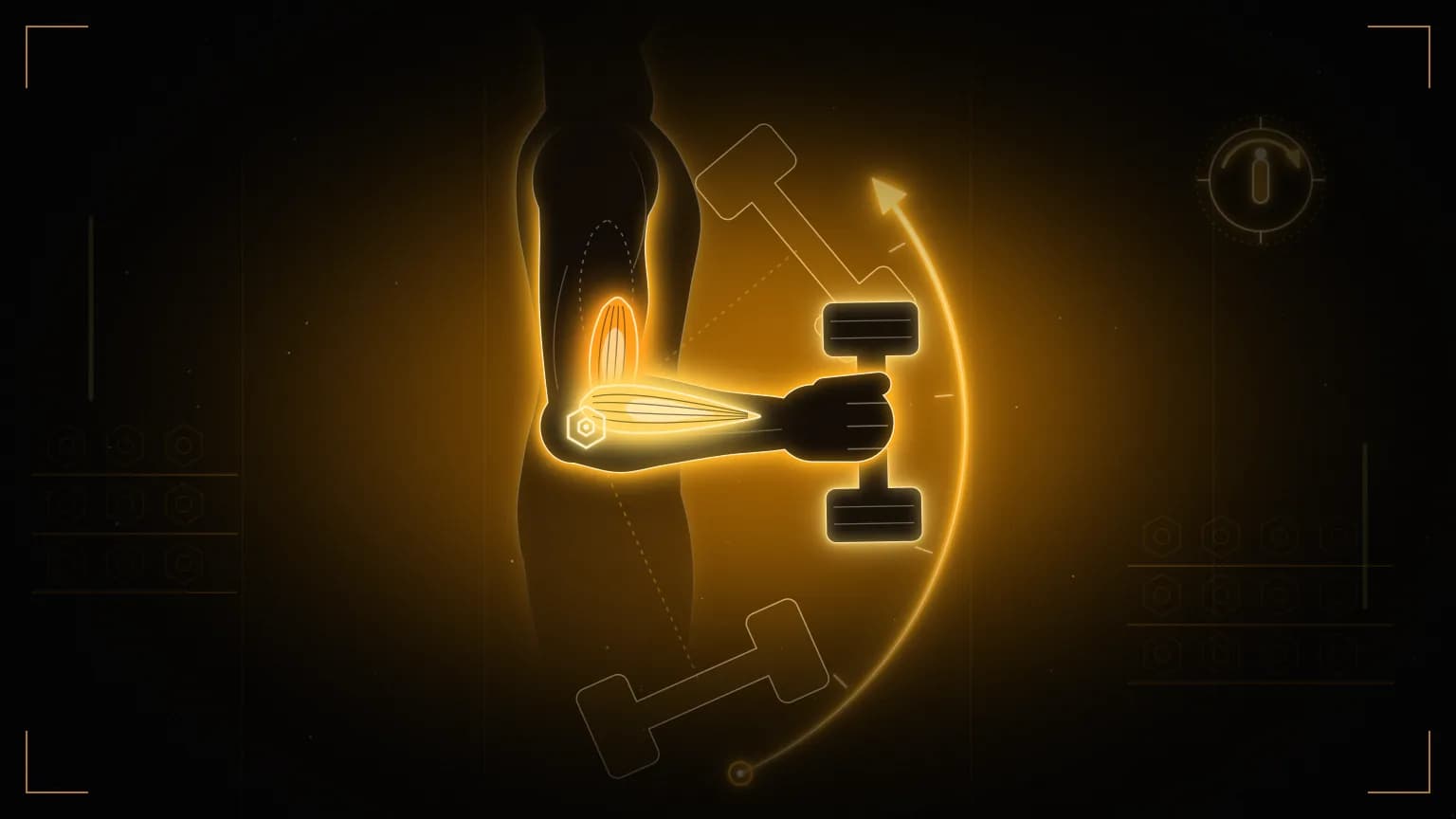
Hammer curls are neutral-grip dumbbell curls: keep your palms facing each other, hold your upper arms still, bend your elbows, and lower the weights under control. They train all three main elbow flexors, including the biceps brachii, brachialis, and brachioradialis, while the neutral grip makes them a useful partner to a palm-up curl.
The exercise looks simple, but clean reps depend on four choices: a load you can control, a stable elbow, a complete comfortable range, and a deliberate descent. Set those first. Then use the standard, cross-body, rope, seated, or alternating version to solve a specific programming problem.
Set up a hammer curl correctly
Stand tall with one dumbbell in each hand. Let your arms hang beside your torso and point your palms toward your thighs. Keep your wrists straight, soften your knees, and brace enough to stop your ribs and hips from swinging.
Move through this sequence:
- Start with your elbows beside your ribs and your shoulders relaxed.
- Curl the dumbbells without turning your palms toward the ceiling.
- Stop when you can no longer bend the elbow without driving it forward.
- Pause briefly while your wrist stays stacked over your forearm.
- Lower each dumbbell until your elbow reaches its starting position.
You do not need to pin your elbows behind your body. Keep them near the side seam of your shirt and let the forearm move around the elbow. A small natural change in shoulder position can happen, but a large forward swing turns the top of the rep into a front raise.
Keep the dumbbell handle centered in your palm. If your wrist bends toward your thumb or little finger, reduce the load and restore a straight line through your hand and forearm. Your grip should hold the dumbbell securely without forcing the wrist into an awkward angle.
Know which muscles hammer curls work
Your elbow flexors share the job of bending your arm. The neutral grip changes their leverage, but it does not switch one muscle on and the others off.
| Muscle | What it contributes | What to remember during a hammer curl |
|---|---|---|
| Biceps brachii | Flexes the elbow and helps turn the palm upward | It still works even though your palm stays neutral |
| Brachialis | Flexes the elbow beneath the biceps | It contributes across forearm positions |
| Brachioradialis | Flexes the elbow from the forearm side | The neutral hand position gives it a clear role in the curl |
| Wrist and finger flexors | Hold the dumbbell and stabilize your grip | Keep your wrist straight instead of curling it with the weight |
An electromyography study of resisted elbow flexion measured the biceps, brachialis, and brachioradialis in neutral, pronated, and supinated forearm positions. All three muscles worked actively in every position. Another study found that hand position changed how the biceps and brachioradialis coordinated during elbow flexion. Those findings support a practical conclusion: treat the hammer curl as a compound elbow-flexion exercise, then use grip choice to vary the task rather than claiming that one grip isolates a single muscle.
EMG measures electrical activity during a task. It does not prove that one curl will build more muscle over months. Choose the variation you can perform through a repeatable range and progress without losing the movement.
Compare hammer curls with biceps curls
A standard dumbbell biceps curl begins with the palm forward or turns the palm upward as you lift. A hammer curl keeps the palms facing each other. Both bend the elbow and train the biceps, brachialis, and brachioradialis.
| Question | Hammer curl | Palm-up dumbbell curl |
|---|---|---|
| Hand position | Palms face each other | Palms face forward or rotate upward |
| Main movement | Elbow flexion with a neutral forearm | Elbow flexion with a supinated forearm |
| Useful purpose | Add neutral-grip elbow-flexion work | Train elbow flexion while the biceps also holds the forearm palm-up |
| Common error | Turning it into a cross-body swing | Letting the elbow drift forward and losing supination |
| Equipment | Dumbbells, rope cable, or neutral-grip handles | Dumbbells, barbell, cable, or curl machine |
You do not need to declare a winner. Put a palm-up curl and a hammer curl in the same week when you want both grip positions, or alternate them between training blocks when your arm day already contains enough work. The arm workout guide shows how curls fit beside triceps training.
Choose your hammer curl weight
Choose the heaviest dumbbell that lets you repeat the same elbow position, wrist position, and range from the first rep through the last. The number printed on the dumbbell matters less than the movement it allows.
Use this quick test. Curl both dumbbells from a still start, pause at the top without leaning back, and lower them without dropping. If you need to bend your knees, drive your hips, shrug, or shorten the bottom half, lower the weight. If every rep stays smooth and you finish the planned range with plenty of effort available, use a slightly heavier dumbbell next time.
The current American College of Sports Medicine position stand found that progressive resistance training improves strength and muscle size across many workable prescriptions. It also found that hypertrophy responds to higher weekly volume, while training to momentary muscle fatigue did not consistently improve outcomes. You can stop a set when another clean rep looks doubtful. You do not need to swing through a failed rep to make the set count.
When you change weight, keep the other variables stable. Use the same variation, hand position, range, and order in the workout. The progressive overload guide explains how to add load or repetitions without changing every part of the exercise at once.
Use the variation that fits your goal
Standard dumbbell hammer curl
Curl both dumbbells beside your torso with palms facing inward. This version gives you the simplest reference rep and makes left-to-right differences easy to see.
Alternating hammer curl
Curl one arm while the other rests at your side. Alternate sides after each rep. This version lets you focus on one elbow and may help you keep the torso still, but do not twist your body toward the working arm.
Cross-body hammer curl
Guide the dumbbell toward the opposite side of your upper chest while keeping your palm neutral. Let the forearm travel diagonally without dragging the elbow across your body. Use a controlled path and avoid throwing the dumbbell toward your shoulder.
Rope cable hammer curl
Attach a rope to a low cable, hold one end in each hand, and curl while your palms face each other. The cable keeps tension through more of the range. Keep your elbows beside your torso and separate the rope ends only as far as your wrists can stay straight.
Seated hammer curl
Sit upright with your feet planted and curl beside the bench. The seated position removes much of the leg drive that can hide an overly heavy load. Avoid leaning back as the dumbbells rise.
| Variation | Choose it when | Watch for |
|---|---|---|
| Standard | You want a repeatable baseline | Both shoulders stay level |
| Alternating | You want to inspect one side at a time | Your torso does not rotate |
| Cross-body | You prefer a diagonal forearm path | Your elbow does not travel across your ribs |
| Rope cable | You want continuous cable resistance | Your wrists stay straight as the rope separates |
| Seated | You want to remove leg drive | You do not lean against the bench to finish |
Program hammer curls on arm day
Place hammer curls after your larger pulling work if back strength holds the priority. Put them earlier on a dedicated arm day if you want to improve the exercise itself. Your push pull legs routine can place them after the vertical pull and row on pull day.
For a simple starting point, use two or three sets of eight to twelve controlled repetitions. The federal Physical Activity Guidelines describe one set of eight to twelve repetitions as effective for strength and note that two or three sets may work better. The ACSM position stand supports progressive resistance training and highlights weekly volume as one factor for hypertrophy. Count your hammer-curl sets beside your other direct biceps work, then use the weekly set guide to judge the total rather than treating every curl as a separate program.
Here are three ways to place the exercise:
| Session | Exercise order | Why it fits |
|---|---|---|
| Pull day | Vertical pull, row, palm-up curl, hammer curl | Your back work comes first and the neutral-grip curl finishes the elbow flexors |
| Arm day | Palm-up curl, triceps press, hammer curl, overhead triceps work | You alternate elbow flexion and extension while using two curl grips |
| Short upper-body day | Press, row, hammer curl | One curl adds direct arm work after the compound lifts |
Rest long enough to repeat your chosen range without turning the next set into a swing. Record the load, reps, and variation. Add a repetition or a small amount of weight only when your last set still matches your first set closely.
Fix the mistakes that change the exercise
You swing your hips
You drive the dumbbells upward with your legs and torso. Lower the load, soften your knees without bouncing, and start each rep after your body becomes still.
You drive your elbows forward
You finish by lifting your upper arms. Stop the rep where elbow flexion ends, or use a seated version until you can keep the upper arm quieter.
You bend your wrists
You curl the dumbbell handle toward your forearm. Keep your knuckles in line with your forearm and use a load your grip can stabilize.
You drop the descent
You reach the top and let gravity return the dumbbell. Lower deliberately until the elbow straightens comfortably, then reset before the next rep.
You turn every rep into a different curl
Your palms rotate upward on some reps and stay neutral on others. Pick one grip for the set. Use a separate palm-up curl when you want supination.
Film a useful form check
Place your phone around waist height at a front-oblique angle. Keep your hands, elbows, shoulders, and hips in frame. Film a complete working set instead of your lightest warm-up.
Review the first clean rep and the last attempted rep. Check whether your elbow moved forward, your wrist bent, your torso leaned, or your range shortened. One comparison gives you a clear correction for the next set.
Get quick answers
What muscles do hammer curls work?
Hammer curls train the biceps brachii, brachialis, and brachioradialis as they bend your elbow. Your wrist and finger flexors also hold and stabilize the dumbbell.
Are hammer curls better than biceps curls?
They use a different grip. Hammer curls keep your forearm neutral, while a standard biceps curl uses a palm-up position. Use both when your program needs both tasks and your total arm volume remains recoverable.
Where should a cross-body hammer curl finish?
Guide the dumbbell toward the opposite side of your upper chest. Stop before your shoulder rolls forward or your elbow travels across your ribs.
How heavy should hammer curls be?
Use a weight that lets you keep your torso still, wrist straight, elbow controlled, and range consistent. Lower the weight when you need momentum or lose the bottom of the rep.
Should you curl both dumbbells together or alternate?
Both approaches work. Curl together when you want a simple bilateral set. Alternate when you want to watch one side closely and can resist rotating toward the working arm.
Check the sources
- Marcolin and colleagues, curl variations and biceps and brachioradialis EMG, PubMed
- Boland and colleagues, the role of the brachioradialis in elbow flexion, PubMed
- Küchler and colleagues, elbow-flexor coordination across hand positions, PubMed
- American College of Sports Medicine 2026 resistance-training position stand, PubMed
- Physical Activity Guidelines for Americans, second edition
- Bodybuilding AI: Coach on Google Play