Programming
Build Your Leg Workout: 7 Exercises and 3 Session Plans
Build a leg workout that grows quads, hamstrings, glutes and calves: 7 exercises, weekly set targets and 3 session plans you can run on your next leg day.
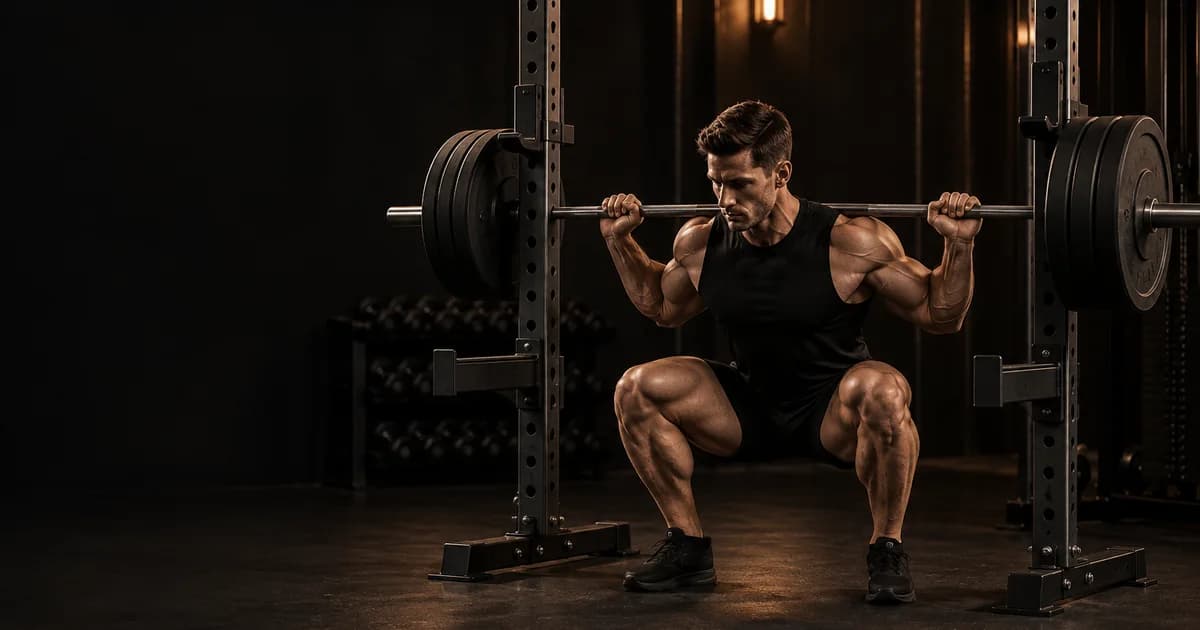
A good leg workout pairs one deep squat pattern, one hip hinge, one hamstring curl and one single-leg movement, then adds quads and calves if you have time. Train legs twice a week, land 10 to 20 hard sets per major muscle across that week, and take most sets within one to three reps of failure. Squat deep, curl seated, and add load only when your range holds.
Below you get the seven exercises worth your time, weekly set targets, and three ready-to-run leg day plans.
What actually grows your legs?
Your quads, hamstrings, glutes and calves grow from enough hard sets, taken through a full range, repeated for months. Four findings shape every plan in this guide.
- Volume drives growth. A 2017 meta-analysis by Schoenfeld and colleagues found a graded dose-response: each extra weekly set added about 0.37% to the average gain in muscle size across 15 studies.
- Depth matters for your glutes and adductors. In a 10-week trial by Kubo and colleagues, full squats grew the gluteus maximus by 6.7% and the adductors by 6.2%, while half squats grew them by 2.2% and 2.7%. Both depths grew the knee extensors by about 5%. Neither depth grew the hamstrings.
- Your hamstrings need their own lift. Because squats barely touched the hamstrings in that trial, you give them a hinge and a curl. Maeo and colleagues trained one leg with seated leg curls and the other with lying curls for 12 weeks. The seated leg grew its whole hamstrings by 14%, the lying leg by 9%. Sitting stretches the hamstrings at the hip, and that longer position appears to help.
- Moderate reps and short rests suit hypertrophy. The American College of Sports Medicine (ACSM) position stand on progression suggests loads of 1 to 12 reps with emphasis on the 6 to 12 rep zone, 1 to 2 minutes of rest, and multiple sets for muscle growth.
Put simply: squat deep, hinge heavy, curl seated, and count your sets.
Pick the 7 best leg exercises
| Exercise | What it trains best | Rep range that works | Form check you can film |
|---|---|---|---|
| Back squat or hack squat | Quads, glutes, adductors | 6 to 10 | Hip crease drops below the top of your knee, heels stay down |
| Leg press | Quads with stable loading | 10 to 15 | Lower back stays on the pad at the bottom |
| Romanian deadlift | Hamstrings and glutes | 6 to 10 | Bar slides down your thighs, back stays flat |
| Seated leg curl | Hamstrings at long length | 10 to 15 | Hips stay pinned, full stretch at the top of each rep |
| Bulgarian split squat | Quads and glutes, one leg at a time | 8 to 12 per leg | Front knee tracks over your toes, torso stays still |
| Leg extension | Quads, especially the rectus femoris | 12 to 20 | Knees lock out fully without swinging |
| Standing calf raise | Calves | 10 to 15 | Heels drop below the step and pause |
Squat to full depth
Set the bar on your upper traps, brace, and sit down between your heels until your hip crease passes your knee. Keep your knees moving in line with your toes. On a hack squat, place your feet mid-platform and let your knees travel forward. Use the depth your hips and lower back can control.
Press through a full leg press
Place your feet shoulder width apart in the middle of the platform. Lower the sled until your knees reach roughly 90 degrees or deeper, and stop before your lower back peels off the pad. Keep your knees soft at the top so your quads hold the load.
Hinge with the Romanian deadlift
Start standing with the bar. Push your hips back, keep a slight bend in your knees, and slide the bar down your thighs until you feel a strong hamstring stretch, usually just below the knee. Drive your hips forward to stand. Your back stays flat from the first rep to the last.
Curl seated for your hamstrings
Line your knee joint up with the machine's pivot, lock the thigh pad down, and lean your torso slightly forward to deepen the stretch. Curl until your heels pass under the seat, then take two seconds to return to full extension.
Split your stance for Bulgarian split squats
Rest your back foot on a bench and stand far enough forward that your front heel stays down at the bottom. Lower until your back knee nearly touches the floor. A longer stance biases your glutes; a shorter one biases your quads.
Extend your knees on the leg extension
Set the pad just above your ankles and grip the handles. Straighten your legs fully, squeeze for one second, and lower under control. This lift trains the rectus femoris, the quad head that neither squat depth grew in the Kubo trial.
Raise your heels slowly on calf raises
Stand on a step with the balls of your feet. Drop your heels as low as they go, pause one to two seconds in the stretch, then rise as high as you can. Bouncing out of the bottom takes the work off your calves.
Set your weekly leg volume
Count only hard sets: sets you finish within about one to three reps of failure. Warm-up sets do not count. Count quads, hamstrings and glutes separately.
| Your training age | Hard sets per muscle per week | Leg sessions per week |
|---|---|---|
| Under 1 year | 8 to 12 | 2 |
| 1 to 3 years | 12 to 16 | 2 |
| 3+ years | 14 to 20 | 2 to 3 |
Start at the low end. Add two sets per week only when your reps still climb and your knees and hips feel fine. The guide on how many sets per muscle per week shows you how to count overlapping work, such as Romanian deadlifts on a back day.
Run one of three leg day plans
Run two leg sessions a week, at least 48 hours apart. On a push pull legs split, these plans slot straight into your leg days. On an upper lower split, use Plan A and Plan B as your two lower days. Rest 1 to 2 minutes on isolation lifts and up to 3 minutes on heavy squats.
Run Plan A: quad focus
- Back squat or hack squat: 3 sets of 6 to 10
- Leg press: 3 sets of 10 to 15
- Seated leg curl: 4 sets of 10 to 15
- Leg extension: 2 sets of 12 to 20
- Standing calf raise: 3 sets of 10 to 15
That gives your quads 8 hard sets and your hamstrings 4.
Run Plan B: hamstring and glute focus
- Romanian deadlift: 4 sets of 6 to 10
- Bulgarian split squat: 3 sets of 8 to 12 per leg
- Seated leg curl: 3 sets of 10 to 15
- Leg press with feet high on the platform: 2 sets of 10 to 15
- Standing calf raise: 3 sets of 10 to 15
Run Plan A and Plan B in the same week and your quads get 13 hard sets and your hamstrings 11. Add sets from the table above once those numbers feel easy to recover from.
Run Plan C: dumbbells and a bench only
- Goblet squat with heels on a small plate: 4 sets of 10 to 15
- Dumbbell Romanian deadlift: 3 sets of 8 to 12
- Bulgarian split squat with dumbbells: 3 sets of 8 to 12 per leg
- Single-leg calf raise holding a dumbbell: 3 sets of 10 to 15
Without a curl machine, slow each Romanian deadlift to a three-second lowering and pause one second in the stretch. When the heaviest dumbbells feel easy, add a pause at the bottom of every squat before you add reps.
Progress without losing depth
Use double progression. Pick a rep range, such as 6 to 10. When you hit 10 clean reps on every set, add the smallest load jump available and work back up from 6. The ACSM position stand suggests a load increase of 2 to 10% once you can do one or two reps over your target. Write down load, reps and how close to failure you went.
A progression counts only when your range stays the same. Ten more kilograms on a squat that stops 10 centimeters higher is a new exercise. Film one working set from the side every week or two and compare the bottom position with your last video. The progressive overload guide walks you through the full decision tree.
Hit your hamstring and calf set targets
Quads usually get plenty of work from squats and presses. Your hamstrings and calves need direct sets, and two 12-week trials show what a working dose looks like. In both, the trained leg did 5 sets of 10 reps at 70% of one-repetition maximum, twice a week, so 10 sets a week.
| Muscle | What the trial found | Your weekly target |
|---|---|---|
| Hamstrings | Seated leg curls grew the whole hamstrings 14%, against 9% for prone curls (Maeo 2021) | Build to 10 sets of leg curls, plus your Romanian deadlifts |
| Calves | Standing calf raises grew the whole triceps surae 5.6%, against 2.1% for seated raises. The soleus grew about the same in both (Kinoshita 2023) | Build to 10 sets, mostly standing |
Plan A and Plan B give you 7 curl sets and 6 calf sets a week. That is a fair start. Add the missing sets one at a time, as the 4-week table below shows. If you plan to compete, judges see your hamstrings and calves in the back double biceps and the back lat spread, so learn those poses in the bodybuilding poses guide.
Follow a 4-week leg progression
Run Plan A and Plan B twice a week for 4 weeks, 48 hours or more apart. Add sets to your curls and calf raises first, then let load do the work. The sets and effort below follow the 1 to 3 reps from failure target and the ACSM load rule from earlier in this guide.
| Week | Leg curl sets per week | Calf raise sets per week | Effort on your last set | Load |
|---|---|---|---|---|
| 1 | 7 | 6 | 3 reps from failure | Start at the low end of each rep range |
| 2 | 9 | 8 | 2 reps from failure | Keep the same loads, add reps |
| 3 | 10 | 10 | 1 to 2 reps from failure | Add 2 to 10% when you beat the top of your range |
| 4 | 10 | 10 | 1 rep from failure | Add load on any lift that reached the top of its range last week |
Treat week 4 as a normal week. Coleman and colleagues had resistance-trained lifters stop training for one week at the midpoint of a 9-week program and found no difference in lower-body muscle growth against lifters who trained straight through. The lifters who trained straight through gained more lower-body strength (Coleman 2024). If you feel run down, cut your sets by half for that week instead of stopping, and keep your reps clean.
When week 4 ends, start week 1 again with 2 to 10% more load on your top lifts, as the ACSM position stand advises when you beat your target reps by one or two.
Swap your plan toward quads or glutes
Your priority decides which lift you swap. Make one change at a time and keep the sets the same.
| Your priority | Swap this | For this | What the studies found |
|---|---|---|---|
| Quads | Leg press | Hack squat or full-depth squat, with leg extensions kept | Back squats grew the quadriceps 3.6 cm² more than hip thrusts in 34 untrained students (Plotkin 2023). Squats did not grow the rectus femoris in the Kubo trial |
| Glutes | Half squats | Full-depth squats | Full squats grew the gluteus maximus 6.7%, half squats 2.2% (Kubo 2019) |
| Glutes, no squat rack | Leg press | Hip thrusts | At equal sets, hip thrusts and back squats grew the gluteus maximus by similar amounts over 9 weeks (Plotkin 2023) |
| Hamstrings | Lying leg curl | Seated leg curl | Seated curls grew the hamstrings 14%, lying curls 9% (Maeo 2021) |
| Calves | Seated calf raise | Standing calf raise | Standing raises grew the triceps surae 5.6%, seated raises 2.1% (Kinoshita 2023) |
The squat and hip thrust study used untrained college-aged students, so read it as a guide for your first year of training. Adductors grew 2.5 cm² more with squats, so keep one squat pattern in your week even when you add hip thrusts.
Train your legs at home with dumbbells
You do not need a machine to grow your legs. A meta-analysis of 21 studies found similar muscle growth with low loads (60% of one-repetition maximum or less) and high loads, as long as every set went to momentary failure. High loads built more maximal strength (Schoenfeld 2017). With dumbbells, you take your sets close to failure and use more reps.
| Exercise | Sets and reps | Notes |
|---|---|---|
| Goblet squat, heels on a small plate | 4 sets of 12 to 20 | Squat to full depth |
| Dumbbell Romanian deadlift | 3 sets of 10 to 15 | Pause one second in the stretch |
| Bulgarian split squat | 3 sets of 10 to 15 per leg | Hold the dumbbells at your sides |
| Single-leg calf raise on a step | 4 sets of 12 to 20 | Drop your heel below the step, pause, then rise |
| Dumbbell hip thrust with your back on a bench | 3 sets of 10 to 15 | Add it when you want more glute work |
Run this twice a week. Stop each set when you could do about one more clean rep. Because high loads build more strength, add a heavier session every few weeks if you have a barbell available.
Track your weekly sets with the bodybuilding training volume calculator, and fit the sessions into your week with the workout split generator.
Fix 5 common leg day mistakes
- Cutting squat depth. Half squats grew the glutes and adductors about a third to a half as much as full squats in the Kubo trial. Lower the load and own the bottom.
- Skipping direct hamstring work. Squats and leg presses leave your hamstrings undertrained. Keep one hinge and one curl every week.
- Rushing the lowering. Take about two seconds down on every rep. Control keeps the tension on your legs and your joints happy.
- Bouncing your calf raises. Pause in the stretch or your Achilles tendon does the work.
- Piling on easy sets. Three sets that end one or two reps from failure build more than six easy ones.
Stop any set that causes sharp knee, hip or back pain, and get a qualified coach or clinician to assess it before you load it again.
Common questions
How many times a week should you train legs?
Train them twice a week. Two sessions let you split 12 to 20 weekly sets per muscle so every set stays fresh and high quality.
Do you need to squat to build big legs?
You need a deep knee-dominant lift. A barbell squat, hack squat or deep leg press all load your quads through a full range. Pick the one you can take close to failure with steady depth.
Should you train legs heavy or light?
Use both. Keep squats and Romanian deadlifts in the 6 to 10 rep range and curls, extensions and calf raises in the 10 to 20 range. Growth comes from effort and range across the whole spectrum.
How many sets of calves do you need?
Build toward 10 sets a week, mostly standing. In a 12-week trial, 5 sets of standing calf raises twice a week grew the triceps surae 5.6% (Kinoshita 2023). Start at 6 sets and add one set at a time.
Are seated leg curls better than lying leg curls?
For hamstring size, yes. Seated curls grew the whole hamstrings 14% against 9% for prone curls in the same 20 adults (Maeo 2021). Use a seated machine when you have one.
Can you build big legs at home?
Yes. High and low loads produced similar muscle growth when sets went to failure (Schoenfeld 2017). Run the dumbbell plan above twice a week, push each set close to failure and add reps or pauses before you add weight.
Are hip thrusts better than squats for glutes?
They grew the gluteus maximus by similar amounts at equal sets in a 9-week trial of untrained students, while squats grew the quads and adductors more (Plotkin 2023). Keep a squat pattern and add hip thrusts if you want more glute work.
How long until you see leg growth?
Track progress over months. Measure your thighs, take photos in the same light, and log your lifts at the same depth. If you want to follow lean mass, run your numbers through the FFMI calculator every few months.
Sources
- Schoenfeld BJ, Ogborn D, Krieger JW. Dose-response relationship between weekly resistance training volume and increases in muscle mass. J Sports Sci, 2017
- Kubo K, Ikebukuro T, Yata H. Effects of squat training with different depths on lower limb muscle volumes. Eur J Appl Physiol, 2019
- Maeo S et al. Greater hamstrings muscle hypertrophy but similar damage protection after training at long versus short muscle lengths. Med Sci Sports Exerc, 2021
- American College of Sports Medicine. Progression models in resistance training for healthy adults, 2009
- Kinoshita M, Maeo S and colleagues. Triceps surae muscle hypertrophy is greater after standing versus seated calf-raise training. Front Physiol, 2023
- Plotkin DL and colleagues. Hip thrust and back squat training elicit similar gluteus muscle hypertrophy and transfer similarly to the deadlift. Front Physiol, 2023
- Schoenfeld BJ, Grgic J, Ogborn D, Krieger JW. Strength and hypertrophy adaptations between low- vs. high-load resistance training. J Strength Cond Res, 2017
- Coleman M and colleagues. Gaining more from doing less? The effects of a one-week deload period during supervised resistance training on muscular adaptations. PeerJ, 2024